
Do i need a partial knee replacement? 7 signs you may be a candidate

"You don't have to wait until your knee is completely worn out to reclaim an active, pain-free life."
Do You Have KNEE ARTHRITIS but Want to Avoid a TOTAL KNEE REPLACEMENT?
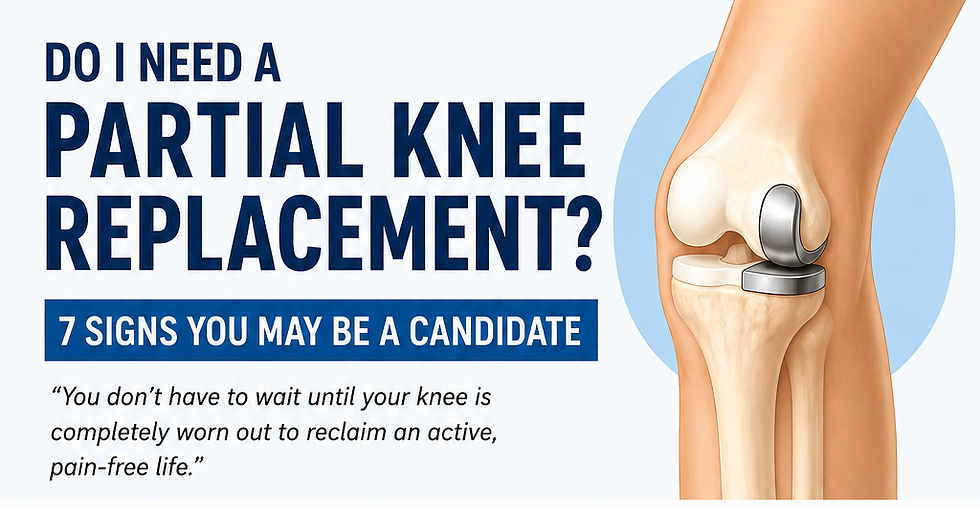
Many people suffering from knee arthritis assume that their only surgical option is a Total Knee Replacement (TKR). However, modern orthopaedic advances now allow selected patients to undergo a Partial Knee Replacement (PKR), also known as Unicompartmental Knee Replacement, preserving much of the natural knee while relieving pain.
If your arthritis is confined to only one part of the knee, a Robotic Partial Knee Replacement may provide excellent pain relief with a quicker recovery, a more natural-feeling knee, and a faster return to daily activities.
What Is a Partial Knee Replacement?
A Partial Knee Replacement is a minimally invasive knee surgery where only the damaged compartment of the knee is resurfaced while preserving healthy cartilage, ligaments, menisci in the unaffected compartments, and bone.
Unlike a Total Knee Replacement, which replaces all three compartments of the knee, a Partial Knee Replacement targets only the affected area. In a Total Knee Replacement, the ACL (Anterior Cruciate Ligament), PCL (Posterior Cruciate Ligament) in many designs, and all menisci are removed as part of the procedure. In contrast, a Partial Knee Replacement preserves much of the knee's native anatomy, helping maintain more natural knee movement.
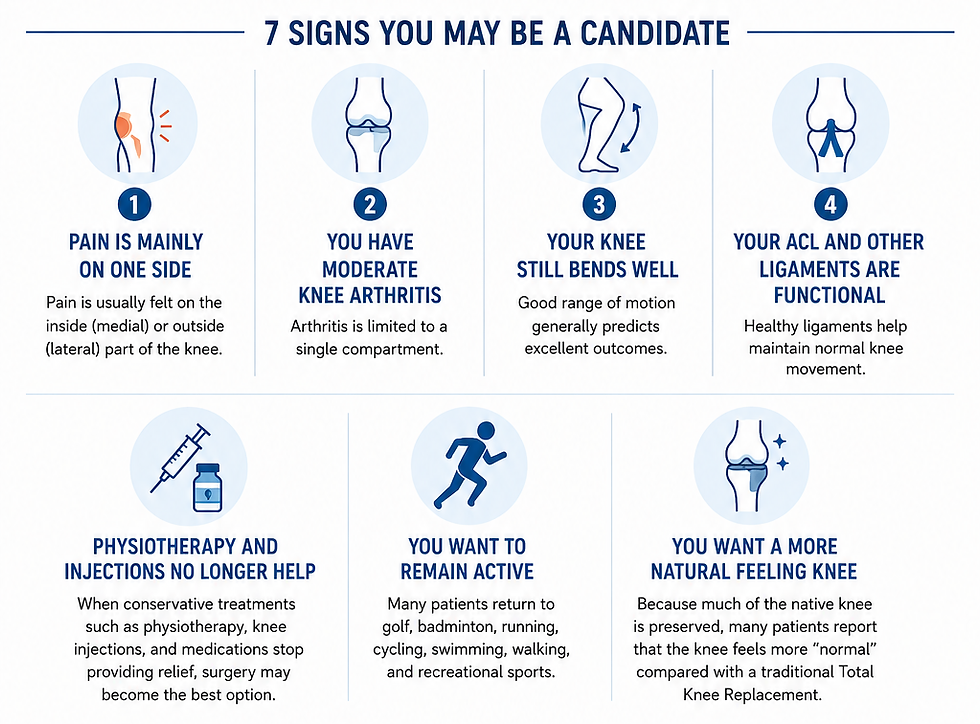
7 Signs You May Be a Candidate
1. Pain Is Mainly on One Side of the Knee
Patients often point to either the inside (medial) or outside (lateral) part of the knee as the source of pain.
2. You Have Moderate Knee Arthritis
If arthritis is limited to a single compartment, you may be an ideal candidate for a Partial Knee Replacement.
3. Your Knee Still Bends Well
Good range of motion generally predicts excellent outcomes after knee replacement surgery.
4. Your ACL and Other Ligaments Are Functional
Healthy ligaments help maintain normal knee movement after surgery. Preserving these structures is one of the reasons many patients experience a more natural-feeling knee after a Partial Knee Replacement.
5. Physiotherapy and Injections No Longer Help
When conservative treatments such as physiotherapy, knee injections, and medications stop providing relief, surgery may become the best option.
6. You Want to Remain Active
Many patients return to golf, badminton, running, cycling, swimming, walking, and recreational sports after a Partial Knee Replacement.
7. You Want a More Natural Feeling Knee
Because much of the native knee is preserved, many patients report that the knee feels more "normal" compared with a traditional Total Knee Replacement.
Research has consistently shown that Partial Knee Replacement patients achieve higher Forgotten Joint Scores (FJS) compared with Total Knee Replacement patients. The Forgotten Joint Score measures how often patients are aware of their artificial joint during daily life. A higher score means patients are less conscious of the implant and more likely to "forget" they even have a knee implant.
Many patients describe this as feeling like they have their own knee rather than an artificial joint.
Benefits of Robotic Partial Knee Replacement
Modern robotic-assisted knee replacement systems such as the MAKO/CORI Robotic Platform provide:
Personalized surgical planning
Better soft tissue balance
Greater precision
Improved implant positioning
Smaller incisions
Less bone removal
Faster recovery
Better preservation of normal knee kinematics
Preservation of healthy ligaments and bone
Higher Forgotten Joint Scores
A more natural-feeling knee
Because the knee's normal anatomy is largely preserved, patients often report that they do not feel like they have an implant inside the knee during everyday activities.
Who Is Not a Candidate?
Partial Knee Replacement may not be suitable if:
Arthritis affects the entire knee
Severe knee deformity is present
Major ligament instability exists
Advanced inflammatory arthritis is present
A detailed clinical examination, digital X-rays, and sometimes MRI scans help determine suitability.
Why Early Assessment Matters
One of the biggest misconceptions is waiting too long. Many patients lose the opportunity for a Partial Knee Replacement because knee arthritis progresses into other compartments of the knee.
Early evaluation by a knee replacement specialist can identify whether a knee-preserving solution is possible.
Conclusion
Partial Knee Replacement can be an excellent option for carefully selected patients with localized knee arthritis. By preserving healthy structures, maintaining normal knee biomechanics, and restoring natural knee movement, it offers faster recovery, improved function, and excellent long-term outcomes.
Importantly, patients undergoing Partial Knee Replacement often achieve higher Forgotten Joint Scores, meaning they are less aware of the implant and more likely to feel that the knee is their own. For suitable candidates, this can translate into a more natural and satisfying outcome compared with a Total Knee Replacement.
Looking for a Partial Knee Replacement Specialist in Bangalore?
Dr. Akshay K. S is an Australia-trained Hip and Knee Surgeon with special expertise in Robotic Knee Replacement, Partial Knee Replacement, and Personalized Alignment Knee Replacement Surgery. He offers advanced assessment and treatment for patients seeking knee preservation, minimally invasive knee surgery, and effective solutions for knee arthritis in Bangalore.
| Dr Akshay K S
Robotic Knee and Hip (DAA) Replacement Surgeon | Sports Injury Specialist | Rapid Recovery & Minimally invasive Orthopaedics | Sahakar Nagar | Bangalore


Comments